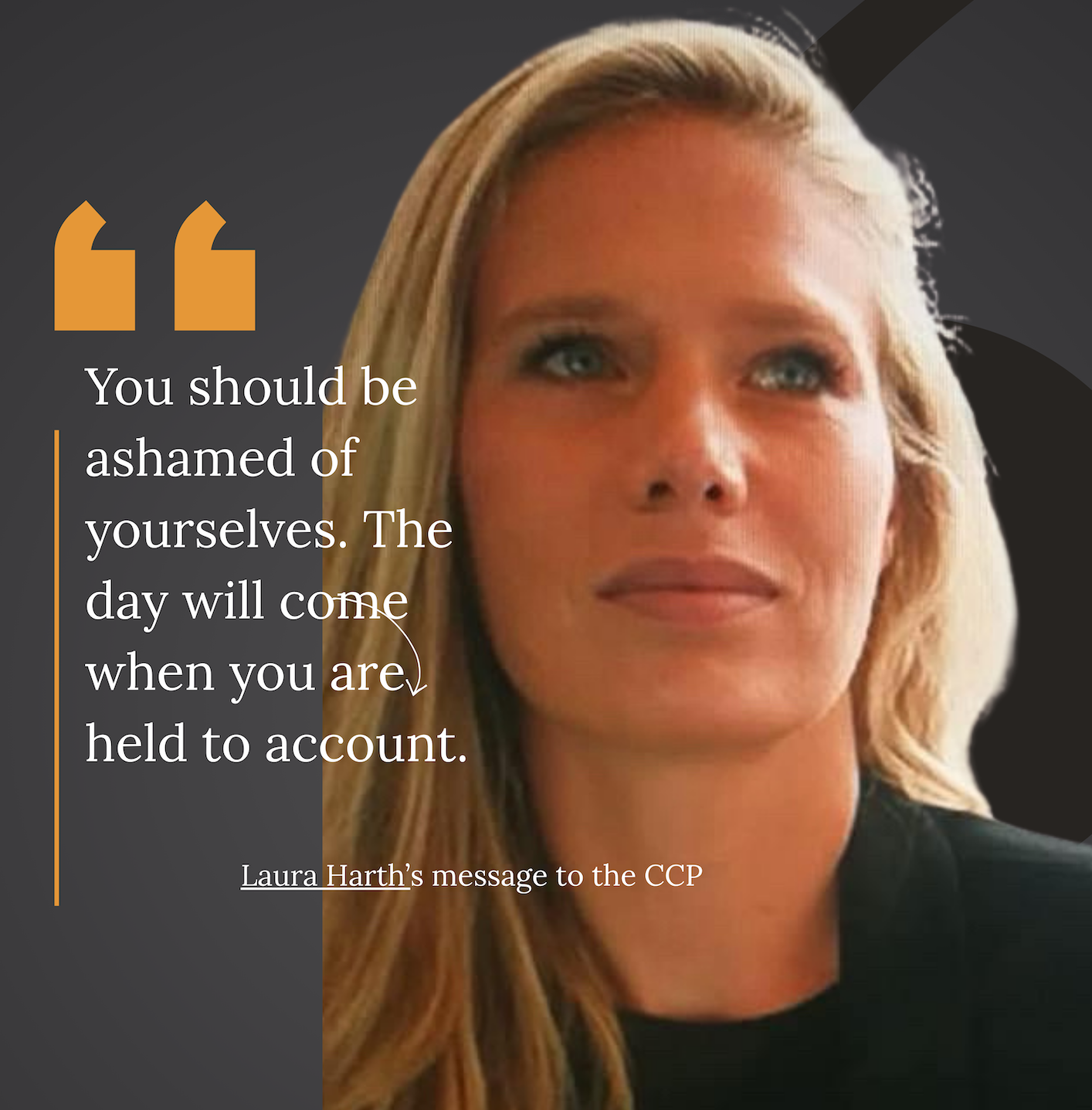
When AI-generated pornographic images targeting human rights advocate Laura Harth began circulating online this spring, she says the goal was not hard to read.
“The CCP expects the victims of these smears and slander campaigns to be intimidated,” Harth told Uyghur News Network. “They expect us to feel too ashamed to talk about this type of abuse publicly, let alone show it. They were wrong.”
Dissidents have lived with this for years. So have Uyghur, Hong Kong and Tibetan activists, and the researchers who track China’s reach abroad. The harassment is familiar — false accusations, fake accounts, threats, sexual smears. What’s new, rights groups say, is AI, which lets whoever is behind it work faster and hit harder.
“China conducts the world’s most sophisticated and comprehensive campaign of transnational repression,” said Yana Gorokhovskaia, Research Director for Strategy and Design at Freedom House and co-author of several studies on authoritarian intimidation abroad.
In Freedom House’s database, which tracks only physical direct incidents between 2014 and 2025, China accounted for 319 of 1,375 recorded cases worldwide — more than Turkey and Russia combined, she said.
“The PRC strives to surveil and harass activists, dissidents, former insiders, international students, journalists and members of religious and ethnic minorities,” Gorokhovskaia told Uyghur News Network.
Harth, China in the World Director at Safeguard Defenders, recently took the unusual step of republishing some of the fake sexualized images made about her — images she says were produced as part of a broader intimidation campaign tied to Chinese state-affiliated influence networks.
“A picture can tell a thousand words,” she said. “I thought it was time to move beyond telling people what was happening, and instead show it.”
The images, marked with “FAKE” watermarks when Safeguard Defenders republished them, depict fabricated explicit scenes generated with AI tools. Harth says colleagues and friends first alerted her to the latest wave in April, after the images began spreading on social media.
“They were careful this time not to tag Safeguard Defenders directly,” she said. “But they did occasionally tag IPAC.”
IPAC — the Inter-Parliamentary Alliance on China — is an international coalition of lawmakers focused on Beijing’s human rights record and foreign influence activities.
Harth rejects any suggestion that responsibility for the campaign is unclear.
“It is not that I think Beijing is behind this campaign,” she said. “We know they are.”
Over recent years, technology firms, government agencies, and research organizations have repeatedly linked coordinated influence operations against Chinese dissidents and critics to networks associated with China’s public security apparatus.
In February 2026, OpenAI publicly identified Safeguard Defenders as a target of what its investigators called “industrialized” transnational repression by China using AI. Meta has separately described the sprawling “Spamouflage” network — which researchers say has harassed activists, journalists, and politicians in many countries — as the largest covert influence operation it has uncovered, with Microsoft, Graphika, the Australian Strategic Policy Institute and the European External Action Service among those documenting its activity.
In April 2023, the U.S. Department of Justice charged 44 people — including 40 officers of China’s Ministry of Public Security — in connection with alleged online harassment and transnational repression operations.
Chinese authorities have repeatedly denied conducting transnational repression or overseas intimidation. In response to earlier accusations involving so-called overseas police stations, officials called the claims “unfounded” and “not worth refuting,” and said the overseas service centers existed to help Chinese nationals with administrative tasks, not to carry out policing abroad.
The Chinese embassy in Washington did not respond to UNN’s request for comment on the allegations.
Safeguard Defenders became a frequent target after publishing reports in 2022 that documented more than 100 alleged clandestine Chinese “overseas police stations.” Beijing denied the findings, but the reports triggered investigations in several countries.
According to Harth, the harassment escalated after those publications and has continued for years.
“Over four years, the same regime that demands to be taken seriously as a great power has accused me and my colleagues of an inventive range of crimes,” she wrote in a recent editorial. “Affairs with politicians on three continents. Corruption. Working for foreign intelligence. Terrorism.”
Rights advocates say women are often targeted with especially sexualized abuse meant to humiliate and isolate them. But Harth says silence only strengthens the tactic.
“Those images are a depiction of the regime in Beijing, not of myself or anyone else targeted in this manner,” she said.
Analysts warn that generative AI is sharply lowering the barrier for authoritarian influence operations. Work that once needed editing teams and coordinated propaganda infrastructure can now be done cheaply and fast.
“AI allows China and other bad actors to scale up their surveillance and intimidation campaigns,” Gorokhovskaia said. “It’s an accelerant of repression.”
She said China’s information manipulation reaches beyond direct repression to target civil society itself. She pointed to RightsCon, the world’s largest digital-rights summit, canceled days before its May 5 opening in Lusaka, Zambia, after what organizers called Chinese pressure over the participation of Taiwanese delegates. Amnesty International called it “a brazen act of Chinese transnational repression.”
Western governments have increasingly criminalized AI-generated sexual deepfakes at home. But critics argue democratic states have been far more hesitant when such campaigns are tied to a foreign government.
“We have the attributions,” Harth wrote. “What we need now is concrete action and accountability.”
Gorokhovskaia said part of the accountability gap comes from how hard digital forms of repression are to prosecute.
“Some forms of TNR like digital targeting or coercion of family members is difficult to prosecute domestically by host countries,” she said, noting that many still lack “a codified definition of transnational repression or awareness among law enforcement.”
Weakening political resolve has played a part too, she said. “As many democracies have pivoted away from the defense of human rights and countering authoritarianism, the political will to stand up to the PRC has weakened.”
As a first step, she said, governments should define transnational repression in law before building broader responses to AI-enabled harassment. “Countries need to codify a definition of transnational repression in legislation in order to have a shared understanding of the phenomenon and to coordinate policy responses,” she said. “Responses to specific tactics, like AI enabled TNR, can flow from that first action.”
Despite the pressure, Harth says the campaign has hardened her resolve.
“Some days, the activist in me prevails,” she said. “Some days, the person in me finds it a bit harder to deal with. But understanding what it is the CCP seeks to achieve helps in maintaining firm against it.”
She said the episode had also strengthened bonds across the dissident and rights community. “While the CCP uses these tactics in part also to divide the community,” she said, “this recent episode has reminded me of how many amazing people I’ve met exactly because of the CCP’s actions.”
She had a blunter message, too, for the Chinese Communist Party.
“You should be ashamed of yourselves,” she said. “The day will come when you are held to account.”



Be First to Comment