Thirty-seven years after the massacre, activists, analysts and lawmakers argue that engagement without accountability helped empower the Chinese Communist Party
WASHINGTON (UNN)— Thirty-seven years after Chinese troops opened fire on pro-democracy demonstrators in Beijing, speakers at a Tiananmen anniversary conference returned to a common argument: the world misread the massacre and is still living with the consequences.
Many pointed to what followed — crackdowns in Tibet, Hong Kong, and East Turkistan and the mass detention campaign launched against Uyghurs and other Turkic peoples beginning in 2017.
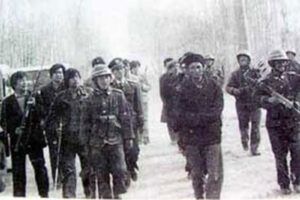
The protests began in April 1989 as mourning for Hu Yaobang, a reformist leader whose ouster and death became a rallying point. Within weeks, students, workers and ordinary Beijingers had taken over the square, calling for democratic reform and an end to corruption. The killing came on the night of June 3, when the army moved in. No one knows the toll — a few hundred by Beijing’s count, many times that by others. Since then, Chinese authorities have censored discussion of the massacre and punished public remembrance.
For Zhou Fengsuo, who took part in the democracy movement as a student leader and now directs Human Rights in China, the decisive question is not what happened on June 4. It is what happened afterward.
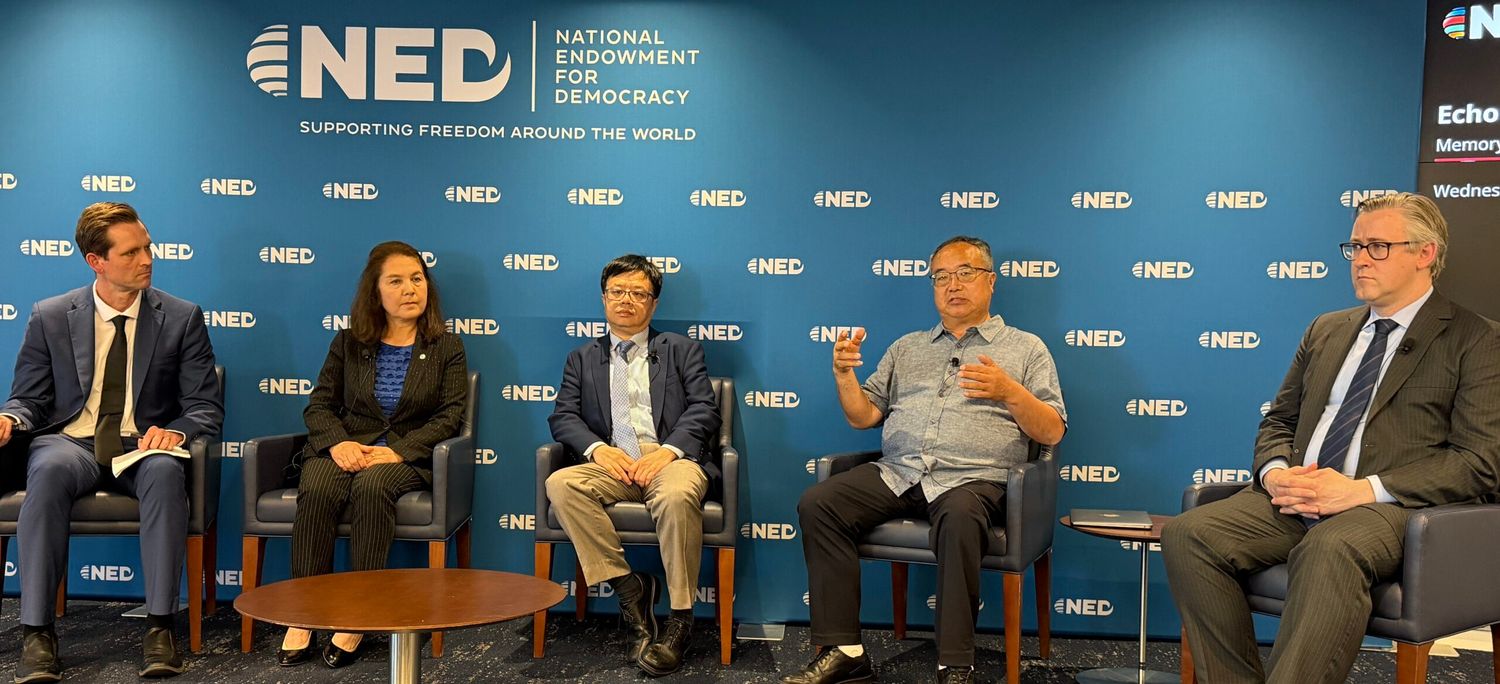
“The world treated Tiananmen as a tragedy, but not as a warning,” he told Uyghur News Network on the sidelines of “Echoes of Tiananmen,” a conference the National Endowment for Democracy hosted Wednesday in Washington to mark the anniversary.
The crackdown had already revealed what the party was, he argued: a government that would turn its army on its own people, and that when challenged, even peacefully, would not stop.
Yet the United States and other democracies eased back into engagement. Trade and investment resumed. Human rights shrank to a line in official statements.
“That was a historic mistake,” Zhou said. It let Deng Xiaoping and the Communist Party recover after killing civilians in the streets — proof, he said, that Beijing could pay no real price and outlast the world’s anger.
That argument ran through the program, which brought together former Tiananmen activists, Hong Kong, Uyghur and Tibetan rights defenders, a Chinese labor organizer, China analysts and lawmakers from Europe and Latin America. They came from different histories but kept asking the same question: What if the world had responded differently after 1989?
Even in 1989, the protests were never only a Beijing story. Dr. Gyal Lo, now a Tibet specialist at the Tibet Action Institute, was a student in Lanzhou that spring, where Tibetans were grieving the death of the Panchen Lama. After Han students attacked their Tibetan classmates, he recalled, hundreds marched under their own banners — “Lift martial law in Lhasa,” “Social justice and equality” — before merging with the larger movement.
Dennis Kwok, a former member of Hong Kong’s Legislative Council, argued that the world has yet to grasp the full consequences of Tiananmen.
“We always remember the fall of the Berlin Wall as one of the most important events of the twentieth century,” he said. “But I don’t think we have fully understood how the Chinese Communist Party survived Tiananmen.”
In 1989, communist governments collapsed across Eastern Europe and the Cold War ended. China appeared to face a similar moment. Instead, the Communist Party survived and tightened its grip.
Peter Mattis, president of the Jamestown Foundation and a former U.S. intelligence analyst, said the party rebuilt how it kept control. Instead of letting opposition grow and then crushing it, it set out to stop movements from forming at all.
“The question becomes: How do you identify those people faster and go after them sooner?” he said.
That logic drove decades of spending on internal security, surveillance and data collection, all of it aimed at finding organizers and breaking networks before they could move.
Erasing the memory of Tiananmen, Mattis said, was part of the same effort. “When memory dies, the event dies. And when the event dies, so does its impact.”
As Tiananmen faded from international attention, trade and engagement expanded. The party grew stronger, not weaker.
For Zubayra Shamseden, co-executive director of the Network for Uyghur Rights, the years after Tiananmen shaped what later happened in East Turkistan, the region China calls the Xinjiang Uyghur Autonomous Region. A student in Shanghai at the time, she joined the protests there in solidarity with Beijing.
“A very important moment was lost,” she said. “If the international community had made China accountable after the Tiananmen massacre in 1989, perhaps later atrocities could have been prevented, or at least made more costly.”
She pointed to what came next. The Ghulja crackdown came in 1997. The Urumqi protest and mass arrests followed in 2009. In 2017, a vast detention campaign began. The United States later designated it a genocide, as did the parliaments of several countries, including Britain and Canada.
“The CCP learned that it could commit abuses, wait for international anger to fade, and then return to business as usual,” she said.
Hong Kong followed the pattern after the 2020 National Security Law: condemnation, then renewed engagement.
It raises a hard question, she said: “What kind of world are we walking into if we continue to treat China only as a market and not as a regime committing crimes against humanity?”
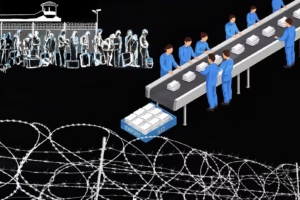
Nine years after the mass incarceration campaign began in the Uyghur region, also known to many Uyghurs as East Turkistan, the world has largely moved on. But repression continues through long prison terms, forced labor, family separation and surveillance. A Financial Times investigation identified 579 detention sites with capacity for about 627,000 people, while studies of Chinese court records estimate that more than half a million Uyghurs and other Turkic people are now imprisoned.
Beijing rejects the charges and works to discredit the evidence. But the danger, she warned, does not stop at the region’s edge.
“The methods developed there — mass surveillance, forced labor, digital control, transnational repression, and the criminalization of identity — can spread everywhere.”
Joey Siu has felt that reach. A student leader in Hong Kong’s 2019 protests and now a program officer at the National Democratic Institute, she became the target of a HK$1 million bounty (about $128,000) from Hong Kong authorities.
“There is a name for what happened to me and many other activists,” she said. “That is called transnational repression.”
The goal, she said, is not only to punish individuals but to intimidate entire communities.
Uyghur activists in the room knew the pattern. The intimidation of family members, Siu noted, had happened to them too.
Frances Hui of the Committee for Freedom in Hong Kong Foundation made the same point: A tool built for use inside China was now being used abroad.
The lawmakers carried the argument past human rights into security and economics.
Dovile Sakaliene, a member of Lithuania’s parliament and its former defense minister, said conflicts involving authoritarian states can no longer be treated as local.
“We all understand that the moment Taiwan is attacked by China, we are going to see financial markets around the world plummet.”
Kacper Plazynski of Poland’s parliament was blunter. Asked whether Russia’s methods resembled China’s approach to Taiwan, he answered: “Not similar — the same.”
No one claimed history would surely have gone another way had governments been tougher after the crackdown. But many speakers said the premise behind engagement deserves a second look — the wager that economic opening would bring political opening, that prosperity would breed reform.
Zhou argued the opposite happened.
“The CCP used the wealth, technology and legitimacy it gained from global engagement to strengthen its control at home and expand its influence abroad,” he said.
Pulling human rights out of China policy now, he argues, would not be hard-headed realism but a surrender — and its costs would not stay contained.
“The CCP has always had global ambitions,” Zhou said. “It wants influence, obedience and control far beyond China.”
He recalled being taught in school that the party would “liberate” humanity and remake the world — a promise that, in practice, meant controlling what people could say, believe and remember.
That ambition now runs on money, surveillance technology and economic leverage. The system built to watch Uyghurs can be exported. The pressure on their families can reach activists and journalists abroad. Taiwan, he warned, may be next.
“If human rights are removed from engagement with the CCP, then there is no real limit to what Beijing can do,” he said. “There is no safe partnership with a government that has no respect for human dignity.”
“The lesson of Tiananmen is not only about remembering the dead,” he said. “It is about understanding the system that killed them.”
“Engagement without accountability did not change the CCP,” Zhou said. “It helped empower it.”


Be First to Comment