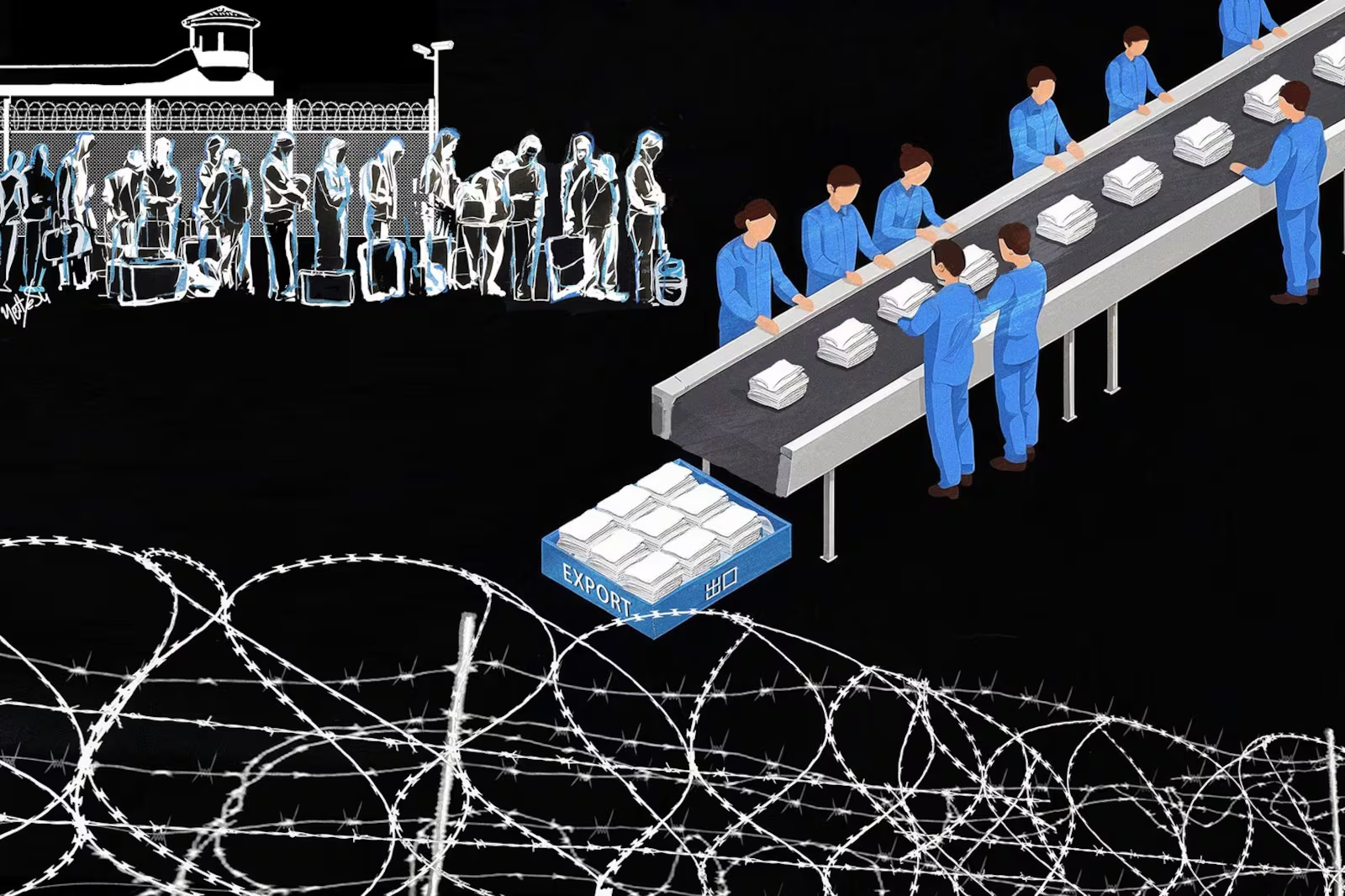
WASHINGTON — Stopping goods made with Uyghur forced labor at the U.S. border does not end the problem. It just moves it.
That is the warning from Elijah Pockell-Wilson, author of a new report on Australia and Japan, two major buyers of Chinese goods with no ban on products made with forced labour.
The real question, Pockell-Wilson said, is not just what crosses a border. It’s whether China’s forced-labor system in East Turkistan still turns a profit.
“Weaker enforcement in mid-sized economies like Australia and Japan won’t change behavior in East Turkistan,” he said. “These markets let high-risk goods linked to forced labor stay economically viable.”
The United States passed the UFLPA (Uyghur Forced Labor Prevention Act) in 2022. It treats anything made even partly in East Turkistan, which China calls Xinjiang, as a product of forced labor. Importers must prove otherwise, or their shipments are blocked. The European Union is preparing a similar ban.
Australia and Japan have no such law. That gap, Pockell-Wilson said, gives companies somewhere to send the products the U.S. and Europe won’t take. When only a few big markets shut their doors, he said, companies look for one that’s still open.
His report, titled “Redirected Risk,” came out June 23. It uses aluminum as one example. After the U.S. law took effect, American imports of Chinese aluminum fell sharply. Imports to Australia and Japan dropped for a time, then rose again.
Pockell-Wilson calls this a split supply chain. A company can make a clean line for American buyers while still selling riskier goods to countries that don’t check. U.S. customs data, he said, shows the same thing.
“Since the UFLPA passed in 2022, CBP has documented supply-chain bifurcation through third countries like Malaysia, Vietnam, and Thailand,” he said.
On the agency’s public dashboard, he added, China has fallen to the fourth-largest source of shipments stopped under the law. “That suggests China has shifted its supply chains to send ‘clean’ goods to the U.S.,” he said.
The pattern shows up elsewhere too, he noted. Researcher Laura Murphy traced how cotton from East Turkistan gets obscured as it moves through other countries’ factories and into the supply chains of over a hundred global brands.
The report uses 2024 United Nations trade figures. It doesn’t claim every item was made with forced labor. It measures how much each country buys from Chinese sectors where the risk is high and outsiders can’t verify the facts.
By that yardstick, Australia bought about $4.82 billion worth of such goods in 2024. Japan bought about $6.71 billion.
Cotton clothing and textiles top the list for both countries, followed by solar parts, aluminum, and industrial chemicals. East Turkistan grows about a fifth of the world’s cotton and 90 percent of China’s. Once that cotton hits the supply chain, it’s hard to trace. It can hide in raw fiber, yarn, fabric, or a finished shirt sewn somewhere else.
For Uyghurs, this goes far beyond trade. It is part of how China controls their lives.
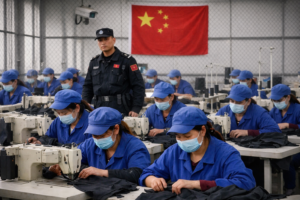
Rights groups say Chinese authorities have detained more than a million Uyghurs and other Turkic people since 2017. They say labor programs send people to factories and farms under heavy surveillance, making independent audits unreliable because workers cannot speak freely.
Pockell-Wilson said weak enforcement abroad preserves the economic value of that system. “The problem isn’t just that forced-labor goods might keep entering foreign markets,” he said. “It’s that weak enforcement helps keep a coercive system profitable.”
In East Turkistan, he said, forced labor is tied to the state’s power to “surveil, transfer, discipline, and control Uyghurs and other Turkic peoples while feeding that coercion into industrial supply chains.” As long as the goods sell somewhere, there’s less pressure to dismantle the system.
Tougher rules in Washington and Brussels alone won’t fix this, he warned. “More enforcement in major economies like the U.S. and E.U. won’t stop China from using Uyghur forced labor to make major export goods,” he said.
He framed it as a question of economic pressure. Scholars like Daniel Drezner have shown that trade curbs only work when they change the costs and benefits a government faces. Others, like Dursun Peksen, have found that sanctions can fail, or even worsen repression, when an authoritarian state can absorb the pressure and shift the cost onto people it already controls.
The lesson, Pockell-Wilson said, is that enforcement has to be coordinated and aimed at the money. “The only viable way forward is to make Uyghur forced labor less economically useful to China,” he said.
Australia’s Modern Slavery Act tells large companies to report their risks. It doesn’t block goods. It carries no real penalty.




Be First to Comment