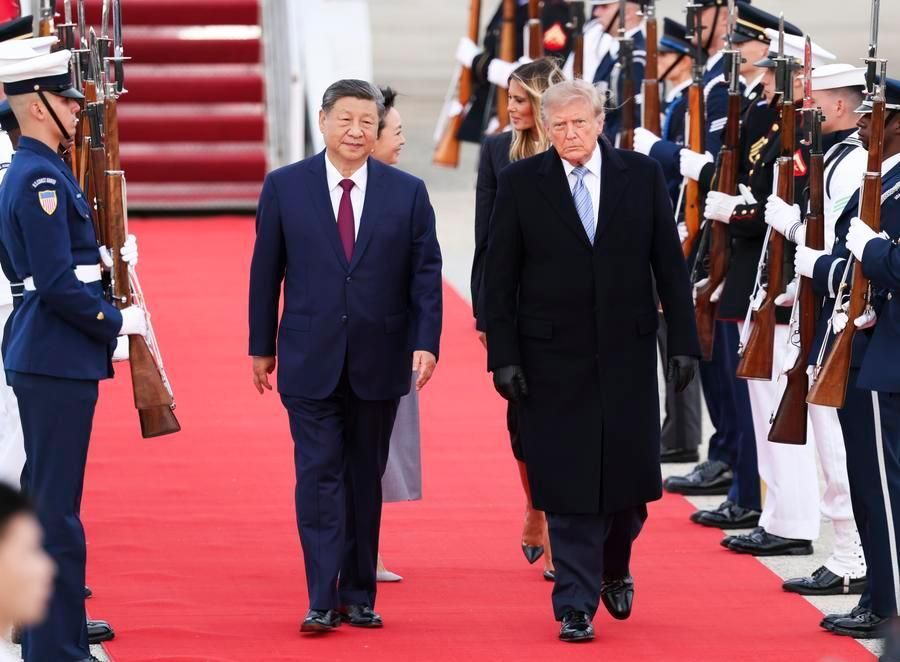
China is committing genocide and crimes against humanity against the Uyghurs and other Turkic Muslim peoples in Xinjiang, the United States declared in 2021. Yet Chinese leader Xi Jinping is in Washington for a state visit. President Trump greeted Xi at Joint Base Andrews with a red carpet.
Secretary of State Mike Pompeo made that determination on January 19, 2021. The Biden administration kept it. In April 2024, Secretary of State Antony Blinken said the genocide was still going on. But the second Trump administration has been silent about it.
How is it normal for the United States to roll out the red carpet for China’s leader when his government has been accused of ongoing genocide?
When I read major American newspapers, I find opinion pieces urging Trump to raise the cases of imprisoned Uyghurs and other prisoners of conscience in China. While raising individual cases is important, I strongly disagree with the premise of these opinion pieces.
The fundamental problem with these appeals is that they treat what is happening in the Uyghur region as merely human rights abuses and arbitrary detentions.
It is disturbing to see that when the discussion narrows to a few prisoners, the true nature of the much darker policy behind them is inadvertently obscured. The question becomes whether Xi might release a few people as a goodwill gesture. He never has to face the question of whether his government should answer for trying to erase an entire people.
China has carried out a mass-detention campaign across the Uyghur homeland since 2017. In 2022, Human Rights Watch estimated that about half a million people remain in the region’s prisons. That number does not include those held in the camps.
In 2017, Chinese authorities took three of my brothers. Two were later released. My brother Ahmetjan was sentenced to 14 years in prison. He was accused of having a foreign connection. That connection was me, a journalist in the United States.
I cannot openly ask about his status, for fear of further reprisals from the Chinese government. His case is among thousands of such cases, and many families suffer the same fate to this day.
Our appeals have begun to sound meaningless. Just meaningless. We beg presidents and politicians to “raise the issue.” We repeat the names of prisoners. Then another summit takes place, another trade deal is signed, another red carpet is rolled out, and the world moves on. Beijing has learned that it only has to wait.
On the contrary, many of them increased their investments in China. Tesla even opened a showroom in Urumqi, the regional capital, at the end of 2021, while the world was learning about the camps.
How shameful is that?
Now technology leaders turn up again and again in official delegations and at state dinners. According to news reports, market access, trade, artificial intelligence, chips and rare-earth minerals are the main topics of the summit.
What about genocide?
The international order has brought China enormous gains. Yet China tries to undermine it and bends its rules whenever they become inconvenient, so that it can get away with its atrocities.
So what happens when international rules no longer restrain powerful states?
The order built after World War II rested on the idea that power alone does not create legitimacy. A government cannot destroy a people simply because they are different. If we give that up, we are back to the law of the jungle.
What happens then to peoples like us?
Uyghurs have no army. We have no state and no seat at the United Nations. We cannot protect ourselves.
Uyghurs survive partly because we believe the world will not let a government do anything it wants to a people. That is why the silence around Xi’s visit frightens me.
The Trump administration should answer a simple question: Does the United States still stand by its 2021 finding that China is committing genocide against the Uyghurs?
If it does, Trump should raise it with Xi directly and show what America stands for. The finding should also shape the trade talks, sanctions, enforcement against forced-labor imports and what the administration says in public.
Saying nothing tells Beijing that enough time has passed. And it tells Uyghurs that even the word “genocide” can be put aside when it becomes inconvenient.
Saying nothing tells Beijing that enough time has passed. And it tells Uyghurs that even a genocide designation cannot save them from state terror.
Things are not normal in the Uyghur homeland. China has spent years trying to make them look normal, and it is getting away with it.


Be First to Comment