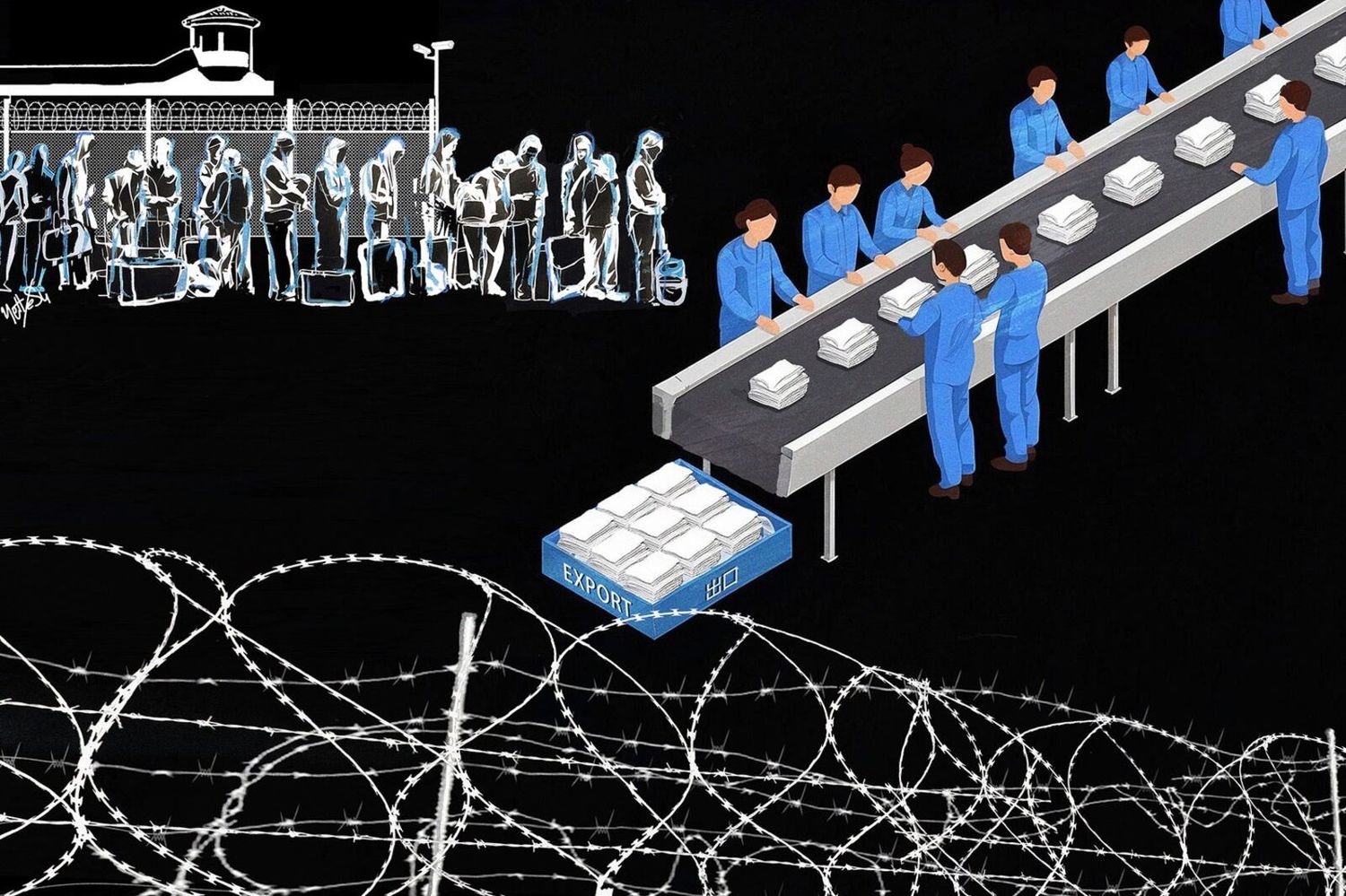
The U.S. added 43 Chinese companies to the UFLPA Entity List. Nineteen are outside Xinjiang, as researchers warn that Uyghur forced labor continues through labor transfers and Xinjiang-linked supply chains across China.
The United States has added 43 Chinese companies to its Uyghur forced-labor blacklist, tthe largest single expansion since the law took effect. The additions include companies outside Xinjiang, the Uyghur homeland that many Uyghurs call East Turkistan.
Adrian Zenz, senior fellow and director of China Studies at the Victims of Communism Memorial Foundation, said the latest designations show that forced labor in Xinjiang is not receding.
“The new designations demonstrate that forced labor not only continues but has intensified in Xinjiang, also as evident from increased exports. The additions are related to new evidence and related reporting on Uyghur forced labor linked to such supply chains, but also because these supply chains are of increased importance for the U.S.”
The Department of Homeland Security announced the additions on July 31. They took effect Aug. 3, bringing the number of entities on the Uyghur Forced Labor Prevention Act, or UFLPA, Entity List to 187.
The UFLPA is aimed at keeping goods linked to forced labor in Xinjiang out of the U.S. market. This was the first expansion of the Entity List since January 2025.
Joshua Kagan, a former Assistant U.S. Trade Representative for Labor Affairs who served on the U.S. government’s Forced Labor Enforcement Task Force, or FLETF, said each company would have been researched and vetted before members voted on whether the evidence supported adding it to the list.
Kagan said he does not know why all 43 were announced at once, but suspects there was a decision at a senior political level that the timing was right. He believes the evidence had been under review for some time.
“It does not seem plausible that the evidentiary files for each of the 43 entities was all simultaneously recently developed by the FLETF, so I assume that the FLETF has been reviewing the evidence for these entities over the last 1.5 years and decided to release them all now.”
Samir Goswami, director of Forced Labor Programs at Global Rights Compliance, said 19 of the 43 companies are outside Xinjiang. He said the risk extends beyond the region through Xinjiang-origin raw materials and labor-transfer programs that move persecuted minorities to workplaces in other provinces.
The government’s classifications make a similar distinction. Four entities were added under a provision covering companies that work with the Xinjiang government to recruit, transport, transfer, harbor or receive Uyghurs, Kazakhs, Kyrgyz or members of other persecuted groups outside Xinjiang.
Forty-one were added under another provision covering entities that source materials from Xinjiang or from people working with the Xinjiang government or the Xinjiang Production and Construction Corps, or XPCC, through government labor schemes. Two entities appear in both categories.
Nyrola Elimä, an Emmy-nominated journalist and independent researcher specializing in supply-chain tracing, forced labor and transnational repression, said an entity-by-entity approach cannot keep pace with the labor-transfer system.
“Nearly half of these new listings are companies outside Xinjiang — Shandong, Jiangsu, Henan. That is the labour transfer system, and it scales faster than any entity list can. An entity-by-entity approach is structurally behind”
The U.S. government says the Entity List is not comprehensive. Federal Register notices state that it should not be treated as an exhaustive list of entities covered by the law.
Kagan said companies must trace their supply chains beyond listed entities. Conventional labor audits, he said, are not considered credible in cases involving state-sponsored forced labor. Companies should check for links to Xinjiang, the XPCC and government labor-transfer programs involving Uyghurs.
Goswami said GRC’s analysis of China’s 15th Five-Year Plan found that the labor-transfer program in Xinjiang is set to expand.
“This is the tip of the iceberg: GRC’s analysis of the 15th Five-Year Plan found XUAR’s forced-labor transfer program is set to expand — on the day the plan was released, XPCC and 18 state-owned firms signed 92 agreements spanning energy, critical minerals, computing, and manufacturing. Enforcement has to scale with that ambition.”
China’s mass crackdown on Uyghurs intensified in 2017, with large-scale detention, surveillance and forced labor. The U.S. began restricting Chinese entities linked to the repression in 2019, followed by sanctions on officials and the XPCC in 2020.
The Uyghur Forced Labor Prevention Act was signed into law in December 2021 and took effect in June 2022, targeting goods linked to forced labor.
China rejected the latest U.S. action. In an Aug. 1 statement, a Commerce Ministry spokesperson said the listings had “no factual basis,” denied forced labor exists in Xinjiang and accused Washington of using human rights to impose unilateral sanctions on Chinese companies.
However, Zenz challenged China’s position and emphasized that Uyghur forced labor is continuing and must be taken more seriously.
“In terms of broader strategy, this communicates to global companies and their suppliers that Uyghur forced labor continues, that the issue must be taken more seriously, and that despite a temporary pause in listings, the US government continues to emphasize and prioritize state-imposed forced labor and its unfair impact on US workers. In that regard, countering Uyghur forced labor is part of the broader China strategy.”
Elimä said the Entity List faces a basic problem: companies are added one at a time, while labor transfers and supply chains can expand faster.
But she said import restrictions should not be judged by whether they can stop forced labor inside China.
“No import control prevents forced labour in Xinjiang. It makes profiting from it more expensive. Confusing the two sets the policy up to fail a test it was never designed to pass. The narrower question is whether it makes Uyghur forced labour unprofitable in the sectors where it’s concentrated, and the answer there is no.”



Be First to Comment