China’s new ethnic unity law could provide legal grounds for more state violence in the Uyghur region, anthropologist Rune Steenberg has warned.
“A change in law that can be implemented by the police and military can of course provide the legal basis for exercises of more violence in the future,” he told Uyghur News Network.
Steenberg is an anthropologist and principal investigator at Palacký University Olomouc. He has carried out extensive fieldwork in the Uyghur region.
In this UNN exclusive, he said the law gives legal force to assimilation policies that were already being enforced.
“The law fixes within the legal system the assimilatory policies that the Chinese government has been pushing ahead in the past decade,” he said. “It turns the policy of forced assimilation into law.”
China adopted the Law on Promoting Ethnic Unity and Progress on March 12, 2026. It took effect on July 1.
Beijing says the law protects ethnic equality, minority languages and economic development. It denies that the measure is intended to assimilate ethnic minorities. Critics say it promotes Mandarin and a single Chinese national identity.
Restrictions on Uyghur-language education began years earlier. They intensified after Chen Quanguo became the region’s Communist Party secretary in August 2016.
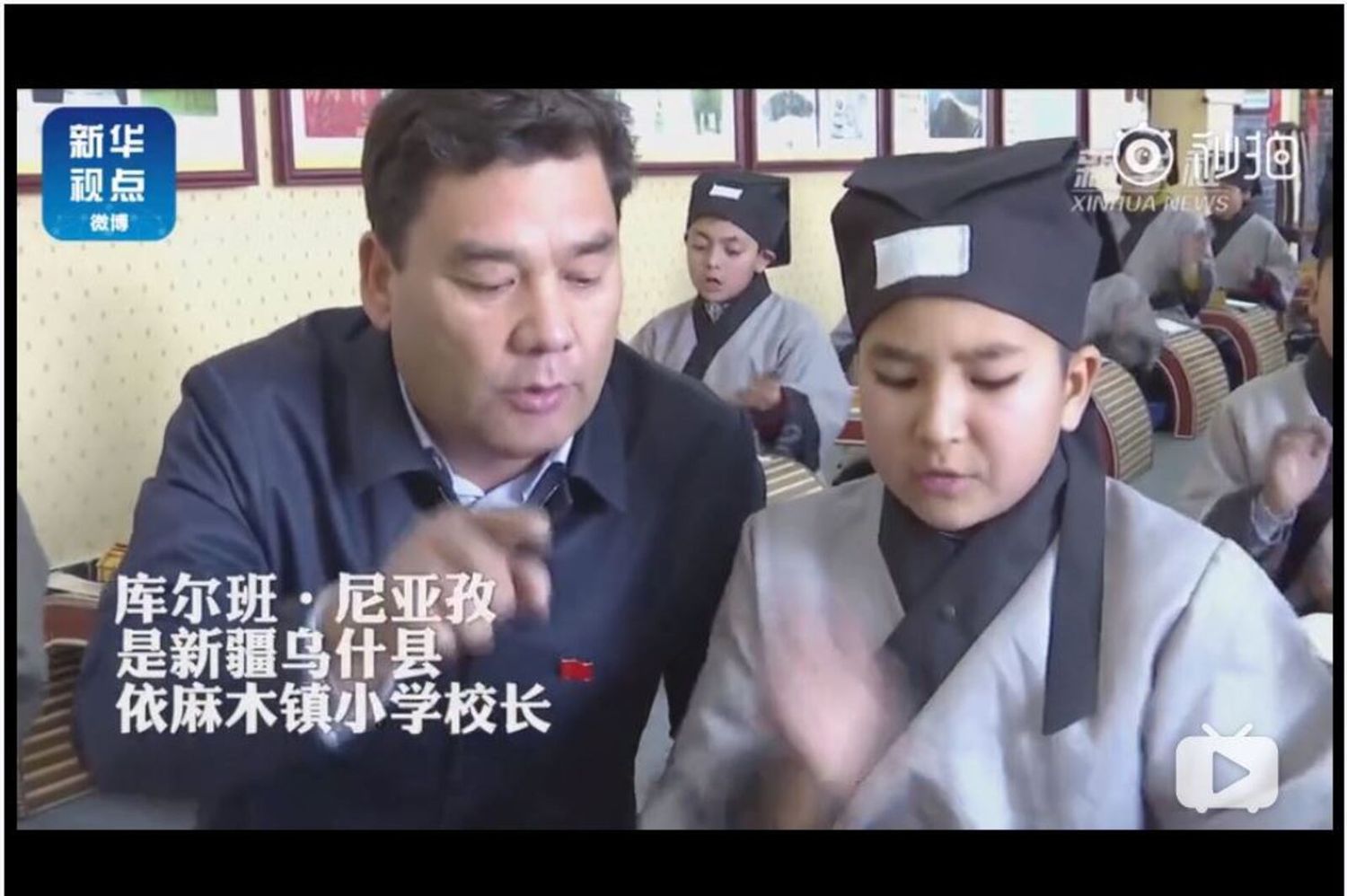
In June 2017, education officials in Hotan prefecture ordered schools to use Mandarin from preschool through secondary school. The directive also banned Uyghur writing, signs and images in schools.
Official figures cited by the US State Department showed that 880,500 children were enrolled in boarding schools across the Uyghur region by 2019.
UN experts later said very young Uyghur children had been placed in boarding schools, preschools and orphanages. They said the children had little access to Uyghur-language education and were taught mainly in Mandarin.
These changes took place alongside mass detention, prison sentences and labour transfers. More than one million Uyghurs and other Turkic peoples are estimated to have been detained since 2017. Some estimates place the figure as high as 1.8 million.
This interview has been edited for length and clarity.
Q1: In simple terms, what is Law of the People’s Republic of China on Promoting Ethnic Unity and Progress?
The law fixes within the legal system the assimilatory policies that the Chinese government has been pushing ahead in the past decade. It turns the policy of forced assimilation into law. It thereby fixes it beyond the point of reversibility in case the political environment should change in the next years and it lays the ground for making any kind of cultural resistance to assimilation legally punishable by law.
The new law ends the relative liberal and supportive system of ethnic- and minority affairs that was introduced after the Maoist period in the 1980s. This system was based on principles of respect for the languages and cultures of other ethnic groups than the Han-Chinese and even though it was repeatedly violated in the presumed interest of security and progress, it lingered beneath the surface as an inhibitor to complete forced assimilation policies. That inhibitor has now been removed. And just like India has cancelled Kashmir’s autonomy status, I would not be surprised if this law proves to be a decisive step towards also cancelling the autonomous status of the so called ethnic autonomous regions in China.
Q2: Since 2017, millions of Uyghurs have been affected by mass detention, many leading Uyghur intellectuals and educators have been imprisoned, and the Uyghur language has been removed from schools, government institutions, and much of public life. If these policies have already been implemented, why did China still find it necessary to enact this new law? What new purpose does it serve?
The law cements these changes in the legal system so they cannot easily be reversed even if politics should change. It also lays the ground for further dismantling minority institutions and cultural support for diversity in order to further push assimilation. The law itself doesn’t change much on the surface of things right now, but it provides the ground-work for a further assimilatory push in the future and for punishing any kind of cultural or social resistance to this assimilation. In important ways it rolls back the relative progress that was achieved in the reform era to protect ethnic minority groups within the PRC and returns to a kind of Cultural Revolution 2.0, only now it is one that is not pushed by fanatic groups of youth in opposition to what many in the established system would want, it has become the established system itself and thus is in need of a legal grounding.
The Chinese government has long known that its policies of ethnic suppression and targeting of indigenous traditions and religion stood in contrast to its declared principles. Even though they rarely if ever upheld them, that were very much built on the commitment to protect ethnic diversity and early socialist ideals of equality between nations. This was the basis on which the autonomous regions were created, including Xinjiang Uyghur Autonomous Region, and entire state financed systems of schooling from kindergarten till university as well as more than ten publishing houses were established.
The autonomous regions were never actually autonomous and the publishing was always subject to censorship, though this varied a great deal in its implementation. The school system and language rights have been systematically dismantled since the late 1990s, and after 2017 only a shadow of the formal system remained amidst heavy cultural destruction by the state. But officially the principles of ethnic equality and autonomy remained in ever growing contrast to reality. That has now been changed. The law and guiding principles have been reformed to more closely match the reality of suppressive assimilatory policies.
Q3: The Uyghur homeland is legally designated an autonomous region. How does this new law change the meaning of autonomy? What powers or protections remain under the autonomy system?
The so-called autonomy of the Uyghurs in XUAR has always had a hollow ring to it. It has never been any kind of real autonomy in the sense of self-governance. Formal structures of administration that were often headed by a Uyghur were always shadowed by a second structure of the Party that held real power and was in effect run from Beijing mostly by Han-Chinese officials. These were and still are basically colonial structures. In some areas, such as cultural and social matters, the local indigenous groups, such as the Uyghurs and Kazakhs were given quite some space and freedom. That is probably as close to autonomy as the policies ever have come. Marriage customs, some religious customs and cultural expressions in the form of dance, songs, poetry, fiction and to a degree social science and humanities were left in Uyghur or Kazakh hands though still supervised and checked by the Party. These freedoms have now been all but completely revoked. Marriage, settlement, housing, history, novels, poetry, music, theater, comedy… all has been put much more strictly under Party control.
As I mentioned before, I would not be surprised if we see a movement to revoke the status of formal ethnic autonomy from the thus far so designated regions and areas in the next few years.
Q4: China frequently says it is governed by the rule of law. But since 2017, many Uyghurs believe constitutional protections have been set aside. Does this new law signal that those legal guarantees have been officially abandoned?
Yes, the new law has changed the legal basis for the so-called autonomy of the ethnic autonomic regions within the PRC so they better align with the actual policies. There was never actual Uyghur autonomy in Xinjiang/East Turkistan but the pretension was there in law and principle. That has now been removed and thus any hope of actual autonomy has been erased – most probably for good. This is a classical step in the process of settler-colonial take-over of indigenous lands. Like the US and Australia are today seen as white, European dominated countries, so too, the aim of the Chinese government is for East Turkistan to become predominantly Chinese. The change of laws is one step on the way there.
Q5: For many years, many Uyghur families have experienced detention, separation, and major changes in education and public life. If schools, public institutions, and the media are all required to promote a shared Chinese national identity, what role is left for Uyghur families in teaching their children their own language, history, and culture?
The teaching of Uyghur religion, history, culture and language has been in the process of being rolled back for at least two decades now. Within this process the Uyghur home and family has been a main place of cultural teaching and passing on of traditions. But whereas up until 2017, the home and family were only controlled in religious and political senses, now the control has also become cultural and linguistic and the Chinese government is actively working to break up families and communities as they are seen as places of reproduction of identities and ideologies that the state is not able to control. Therefore children are increasingly sent to boarding schools, young men and women are taken on labour transfers far away and particularly men are being incarcerated in very high numbers. Also the surveillance of the family, house and community have been stepped up immensely with cameras, phone checks and government designated “relatives” who visit minoritised people’s homes on a regular basis. This all contributes to working against the family or home as a place for cultural reproduction and pushes these activities further underground thus also potentially criminalising them.
Q6: Over the past ten years, Uyghur society has experienced sweeping changes in education, language, religion, and family life. Looking ten years into the future, what kind of society do you believe this law is intended to produce, and what do you think will remain distinctively Uyghur?
The law is intended to produce an assimilated Uyghur society that acts, speaks and thinks essentially like Han-Chinese. That will not happen, we can say that for certain. Just the experience of discrimination, which btw is a side-effect of state implemented policies to make it less attractive to be Uyghur and to break Uyghur networks, will in itself make it impossible for Uyghurs to fully assimilate even if they wanted to. What I do think is likely though and which will probably be acceptable to the government is a further precariarisation of ethnicity status. By this I mean that those who do not agree to assimilate quite far down the line or are incapable of doing so become a marked under-class within Chinese society even more than they already are. Until 2017, an Uyghur society with its own elites and own economic strength still existed in East Turkistan. It was weaker and more vulnerable than the Han-Chinese of course but it was still capable of amassing great wealth and producing a mass of modern cultural products. It had its own economy that worked within but also in some ways in parallel to the Chinese economy and it did constitute a counter-weight to Chinese dominance state ideology, especially from the perspective of regular Uyghurs living in the south of the region. That is no longer the case now and within the next ten years anyone who aspires to an elite position or probably even to a normal middle class life, will have to accept assimilation to a much higher degree than has hitherto been the case. Those who do not do this, whatever their reason, will become a targeted, discriminated underclass or forced to live their ethnic traditions in secrecy.
The racism and islamophobia of Han-Chinese society is increasingly becoming the divisive essence for Uyghurs once they have learnt perfect Mandarin and agreed to assimilate in religious and cultural senses. I think this day is still far in the future. My impression is that every Uyghur who had finished primary school in 2017 and possibly their children, too, will continue to carry a strong Uyghur identity within them for the rest of their lives. Uyghur identity was as strong as it had ever been in 2016, when I last visited the region and in certain respects, I am almost sure that the years of mass-incarceration and heavy police targeting of 2017-2020 have contributed to an even more solidified identity for the majority of these even though the possibilities of expressing it openly have diminished. If people can be expected to live till 70 years of age, then that means that we have at least 50 years and possibly even 80 years ahead of us where the majority of East Turkistan’s indigenous population, which after all makes up something like half of its total population will still carry within them a strong Uyghur (or Kazakh or Kyrgyz or Tajik or Hui) identity. Many of them can be expected to be able to pass this on to their children and so it is only after another 80 years or so, that a scenario becomes realistic where Uyghur identity may slowly disappear and the discrimination Uyghurs may become a main factor in reproducing it.
Q7: From an anthropological perspective, can a state successfully reshape a people’s language, identity, and collective memory through law and public policy? Do you believe China can achieve what this law ultimately intends to accomplish?
A state can reshape people’s language, identity, and collective memory, but there are two main caveats to its success. Firstly, it almost never goes the way it is intended. Social life is so complex that it is near impossible to anticipate and control all variables which means that the result may be successful in some areas (like all Uyghur children learning to speak good Mandarin and knowing the Chinese cultural holidays) but misfire in others (like the new generation being rootless and estranged or ethnic tensions rising in spite of cultural and linguistic assimilation). We don’t know what side-effects it will create, we don’t know how successful each element in the large policy will actually be medium- and long term. Secondly, the law and policies are not enough. People and society are usually very invested in their ways of living, customs, languages and beliefs. It takes serious violence to get them to give this up. We see that clearly in East Turkistan. Laws and policies limiting the number of children and curbing religious practice were in effect long before 2017 and particularly before 2014, and yet many Uyghur families had five or more children and religious practice had been rising after 2009. It was only when the state used violence to limit these practices that substantial change took place. The cultural changes that the Chinese government is enforcing in East Turkistan now are not just the result of law and policy. They are the after-effect of violence crystallising into fear and thus compliance. What types and degrees of violence will have to be exerted in the future to further destroy Uyghur culture and language remains to be seen. A change in law that can be implemented by the police and military can of course provide the legal basis for exercises of more violence in the future and I am afraid that we can pretty confidently say that it most probably will.


Be First to Comment