
As China prepares its next five-year economic plan, experts warn that in the Uyghur region it is set to entrench post-2017 systems of surveillance, labor control, and cultural management—deepening a model of rule built on long-term, high-intensity control.
According to news published on the regional government’s official website on Dec. 22, authorities in the Uyghur region—officially called the Xinjiang Uyghur Autonomous Region by Beijing, but referred to by many Uyghurs as East Turkistan—have begun soliciting opinions on draft versions of a government work report and the outline of China’s 15th Five-Year Plan, which will guide policy from 2026 to 2030.
At a consultation meeting cited in the same release, Erkin Tuniyaz, the region’s chairman, said the plan would be formulated in line with decisions of the Communist Party’s Central Committee, the requirements of the regional Party leadership, and local conditions, while better reflecting the expectations of people of all ethnic groups. He described the coming planning period as a “critical stage” for consolidating foundations and advancing modernization.
On paper, the goals resemble those outlined across China: high-quality growth, industrial upgrading, infrastructure investment, and improved livelihoods. In the Uyghur region, however, analysts say the plan cannot be separated from a governance framework that has been in place since 2017—one that tightly integrates economic planning with security management, labor policy, and cultural control.
A Strategic Region, Defined by Stability
Central to the plan’s regional implementation is the framework Beijing calls the “Five Major Strategic Positionings.” Under it, the Uyghur region is designated as a hub for Asia–Europe connectivity and China’s westward opening, a strategic support point in the national development model, a base for energy and resource security, a major supplier of agricultural and livestock products, and a strategic barrier safeguarding national and geographic security.
Together, these roles place the region at the center of Beijing’s ambitions to secure supply chains, expand westward trade routes, and stabilize its borders. Regional officials have repeatedly emphasized that fulfilling these roles depends first and foremost on stability.
“The region is being treated primarily as a strategic space,” said Ondřej Klimeš, a researcher at the Oriental Institute of the Czech Academy of Sciences who studies Chinese state policy and governance in the Uyghur region. “Economic, cultural, and social policies are increasingly subordinated to national and geopolitical objectives.”
In this framing, analysts say, stability is not an outcome of development but a precondition for it—shaping how economic growth is pursued and how society is governed.
What Changed After 2017 — and Why It Still Shapes the Plan
The importance of stability in the current plan cannot be understood without reference to the period between 2017 and 2021, when governance in the Uyghur region underwent a profound transformation.
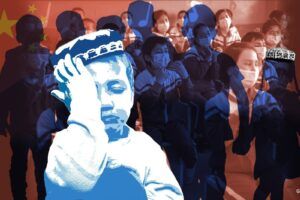
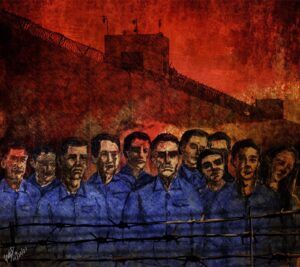
During those years, researchers documented mass arbitrary detention, intrusive surveillance, forced sterilization of Uyghur women, restrictions on religious and cultural life, and large-scale labor transfers—findings corroborated by leaked state documents, satellite imagery, and survivor testimony.
In January 2021, the United States determined that China was committing genocide and crimes against humanity against Uyghurs, a conclusion later affirmed by the Biden administration and echoed by the New Lines Institute and an independent Uyghur Tribunal in London.
In August 2022, the Office of the United Nations High Commissioner for Human Rights concluded that China’s actions in the region may constitute international crimes, in particular crimes against humanity. Amnesty International and Human Rights Watch described similar patterns of systemic abuse.
While Chinese authorities reject these assessments, analysts say the relevance of this period lies in the fact that the governance structures created then were not dismantled. Instead, they were absorbed into routine administration—a process now reflected in long-term planning documents.
For many Uyghurs, today’s policies are rooted in a longer history. Chinese Communist forces entered the region in 1949, shortly after the founding of the People’s Republic of China. Beijing describes the move as a peaceful liberation; many Uyghurs view it as the invasion of East Turkistan, followed by prolonged occupation, decades of political control, and recurring campaigns targeting local identity.
Development, Forced Labor, and the Logic of Integration
Labor policy sits at the center of this continuity.
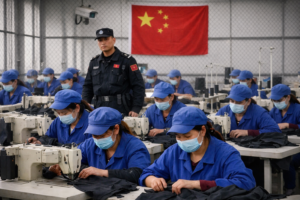
Chinese authorities have long described “labor transfer” and employment programs in the Uyghur region as “poverty-alleviation” and “stability measures”. Critics argue that these policies function as instruments of forced integration, binding Uyghurs into national supply chains under conditions of limited choice.
“The plan signals the Communist Party’s intent on continuation and even strengthening of the previous policies of the Xi era, including forced labor,” Mr. Klimeš said. “The CCP vows to further integrate the Uyghur Region’s economy with China’s interior and with its global economic strategy.”
He has emphasized that this integration operates through multiple channels, including compulsory employment within the region and the transfer of Uyghur laborers to factories in China’s interior provinces under programs such as “partner assistance to Xinjiang.” In this framework, labor is not simply a matter of economic participation, but a mechanism of governance.
In this framework, labor is not simply a matter of economic participation, but a mechanism of governance.
For Rune Steenberg, an anthropologist and principal investigator at Palacký University Olomouc, who has conducted extensive fieldwork in the Uyghur region, the concern extends beyond labor transfers themselves.
“The plan suggests a more mechanised and larger-scale economy,” Steenberg said. “This will probably mean less chances for Uyghurs to be involved in the economy in leading, managing or owning capacities.”
He noted that these structural shifts intersect with the dismantling of Uyghur social structures since 2017.
“Along with the dismantlement of Uyghur culture and social structure and the ongoing fragmentation of Uyghur communities,” Steenberg said, “it means a precariarisation of large parts of the Uyghur population and little choice but to engage in factory labour and labour transfers under bad conditions.”
Steenberg also warned that automation and land consolidation could deepen vulnerability rather than reduce coercion.
“The rise in mechanisation, digitisation and AI, along with the land grab that has taken place since 2017, may even mean that unemployment becomes a bigger problem than labour transfers and coerced labour.”
Social Control as Everyday Governance
Analysts say these labor policies cannot be separated from the broader system of social control that has shaped governance in the Uyghur region since 2017.
Although the most visible aspects of mass detention have drawn less attention in recent years, surveillance, political vetting, neighborhood-level monitoring, and workplace oversight remain embedded in daily life. Employment itself has become a site of governance, where participation and discipline are closely linked.
“There is a normalisation happening,” Steenberg said, “but it is not exactly of the very violent situation in the years 2017–2021. It is coloured by those years, but an easing of some policies and the creation of a more sustainable regime of control has been created since that now seems to become solidified.”
Mr. Klimeš argues that this normalization reflects the party-state’s long-standing view of the region as a security concern rather than a social one.
“The fact that the CCP regards its New Frontier as crucial in state security and global strategy implies continuing normalization and standardization of its long-term governance approach,” he said. “The interests of Uyghurs and other nations of East Turkistan will likely continue to be of limited priority in the party’s thinking.”
Cultural Dismemberment and Substitution
Cultural policy under the 15th Five-Year Plan reflects a shift from episodic repression toward long-term structural transformation.
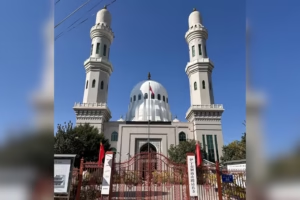
Since 2017, Uyghur language use, religious practice, place names, and cultural expression have been sharply curtailed. Mr. Klimeš describes this trajectory as part of a broader project of forced assimilation.
The shift is visible in the physical landscape. Human Rights Watch has documented coordinated changes to street and village names across the Uyghur region, including in Kashgar, where Uyghur names were replaced with standardized Mandarin ones; about 630 villages were renamed, often removing references to Uyghur history, religion, or cultural life. Chinese authorities describe the changes as modernization, while researchers say they erode Uyghur cultural presence in public space.
“The Xi-era forced assimilation of Uyghurs and other nations of East Turkistan is also likely to continue under the guise of building the consciousness and community of the so-called Chinese nation,”
Steenberg argues that what has followed is not restoration, but replacement.
“Uyghur culture is being destroyed and substituted,” he said. “The Chinese government has, with its very repressive policies in 2017–2021 and its normalisation of the surveillance and fear they brought, managed to destroy substantial parts of Uyghur culture and society.”
He said authorities are now investing heavily in what he described as a state-curated “Xinjiang culture,” intended to fill the void left by that destruction.
“From the outside it can sometimes be difficult to distinguish between actual social structure and community on the one side and make-believe propaganda smoke screens on the other,” Steenberg said. “But to people on the ground and to those who know the region intimately from before 2017, the difference is painfully real.”
Stability Without Exit
Taken together, analysts say, forced labor, social control, cultural dismemberment, and forced integration form a coherent system—one designed not for temporary crisis management, but for permanence.
Some scholars caution, however, that the system has evolved since its most visible and violent phase between 2017 and 2021. Rune Steenberg notes that while certain overt measures have been scaled back, they have been replaced by what he describes as a more “sustainable regime of control,” one that embeds surveillance, labor discipline, and political compliance into everyday economic and social life rather than relying on mass detention.
Similarly, Ondřej Klimeš argues that the emphasis on long-term planning reflects the Chinese Communist Party’s effort to normalize governance in what it views as a strategically vital frontier. In this framework, he says, stability is treated less as a temporary objective than as a structural requirement for national security, regional integration, and global strategy—leaving little room for policy reversal even as tactics change.
“China’s Han Nationalist regime does not know how to loosen controls on minorities,” said Gordon a China analyst and senior fellow at the Gatestone Institute. “There is no reverse gear when it comes to Uyghurs and other Turkic minorities.”
For Uyghurs, analysts say, the 15th Five-Year Plan offers economic participation without autonomy, cultural inclusion without institutional support, and safety defined as political compliance.
Five-Year Plans in China function not only as economic road maps but as governance signals, shaping official incentives and defining policy boundaries. In the Uyghur region, the new plan suggests continuity—development and stability advancing together under a system of control refined rather than reversed.
As the plan moves toward formal adoption, attention is likely to focus less on promised prosperity than on the durability of the governance model beneath it—a model in which stability is not a goal to be achieved, but a condition to be enforced.

Mamatjan Juma is the Executive Director of Uyghur News Network (UNN) and a longtime newsroom leader with more than 18 years of experience in international journalism. He previously served as Deputy Director of Radio Free Asia’s Uyghur Service, where he managed editorial operations, standards, and cross-language workflows and helped guide major coverage of China’s mass detention system, forced labor networks, and the expanding surveillance state in the Uyghur region (East Turkestan).
Under his editorial leadership, RFA’s Uyghur Service received major journalism honors, including the Burke Award (2019) and the MINS Award for excellence in international broadcasting. Its reporting has been cited by major international outlets, helping shape global understanding of the crisis. Juma is fluent in Uyghur, English, Mandarin Chinese, and Uzbek, and also works as a translator.


Be First to Comment