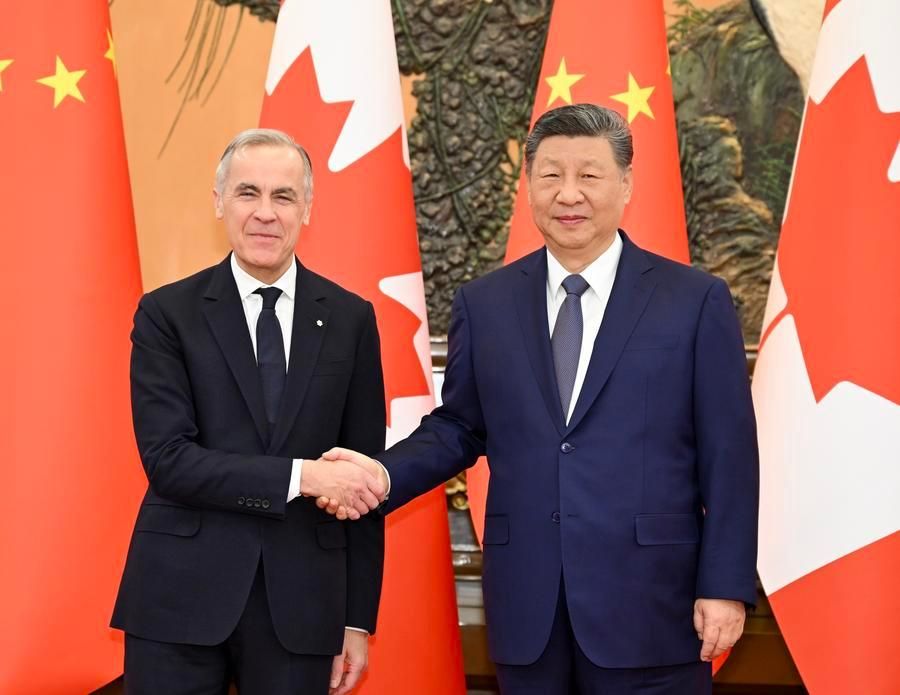
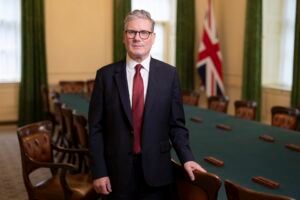
Canadian Prime Minister Mark Carney’s mid-January visit to China has drawn criticism from human rights advocates after he praised President Xi Jinping’s leadership and promoted a “new world order” while remaining silent on the Uyghur repression.
When Canadian Prime Minister Mark Carney arrived in Beijing in mid-January, he praised the leadership of Chinese President Xi Jinping and spoke of preparing Canada for what he described as a “new world order.”
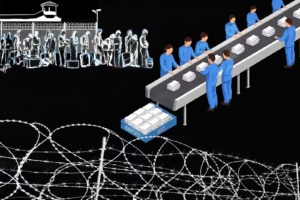
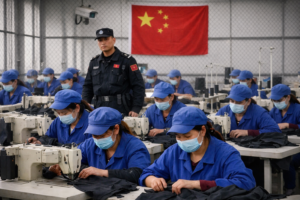
What he did not mention publicly was China’s mass detention, forced labor, and systematic repression of Uyghurs, abuses that Canada’s Parliament overwhelmingly recognized in 2021 as genocide. Nor did he address Beijing’s wider campaign against other religious communities, civil society figures, lawyers, and political critics. For Uyghur advocates, the silence was not a diplomatic nuance but a stark signal that accountability was absent from the agenda and that Canada’s stated commitment to Uyghur rights may be receding in practice.
The visit, the first by a Canadian prime minister since 2017, was framed by Ottawa as pragmatic engagement in an increasingly fragmented global landscape. Critics, however, say the approach exposed a growing contradiction between Canada’s parliamentary commitments and its executive diplomacy, with consequences for human rights, credibility, and long-term leverage.
Silence on the Uyghur Issue
For some analysts, the most consequential omission of Prime Minister Carney’s Beijing visit was not a tactical error, but the choice to leave human-rights issues unaddressed.
Michael Kovrig, a former Canadian diplomat and senior Asia adviser at the International Crisis Group, said the absence of Uyghur and other human-rights issues from top-level diplomacy is not neutral.
“For Uyghurs and other non-Han peoples inside China, the absence of rights issues from top-level diplomacy isn’t neutral—it’s exploitable,” Mr. Kovrig said. “Beijing wanted momentum and optics to validate its narrative that relations deteriorated because Ottawa followed Washington. The language of ‘new starting points,’ ‘turning points,’ and ‘strategic partnership’ is designed to manufacture trajectory and normalize the CCP’s preferred story.”
He warned that even carefully hedged engagement can be repurposed by Beijing’s propaganda system.
“Even when Ottawa’s messaging stresses ‘predictability, guardrails, phased implementation, and reversibility,’ Chinese state media can still frame renewed engagement and any praise for ‘cooperation’ as international endorsement, and use it to legitimize policies at home while demoralizing diaspora communities abroad,” he said.
“That’s why optics matter,” Mr. Kovrig added. “Formal, deliberately cool choreography may signal ‘talking without committing,’ but the propaganda machine can still turn ‘talking’ into ‘validation’ if Canada does not actively deny narrative concessions.”
Canada’s House of Commons voted overwhelmingly in 2021 to declare China’s treatment of Uyghurs and other Turkic peoples a genocide, a determination that remains formally in place. Yet during Mr. Carney’s meetings with China’s top leadership, and in the government’s public statements announcing a new strategic partnership, there was no reference to Xinjiang, forced labor, mass detention, or accountability.
Mehmet Tohti, executive director of the Uyghur Rights Advocacy Project in Ottawa, said Prime Minister Carney did not raise the issue during his meetings with Chinese leaders.
Mr. Tohti said he does not believe any Canadian government is currently prepared to confront Beijing on an issue as politically charged as genocide recognition while it perceives itself to be under sustained economic and security pressure.
“China’s position on the world stage has been elevated to the point where it is now widely viewed, rightly or wrongly, as a source of stability and predictability in trade and international relations,” Mr. Tohti said. “In this environment, countries seeking economic growth and financial stability are prioritizing predictability and continuity over confrontation on human rights.”
He said Canada’s posture reflects a shift visible beyond Ottawa.
“This is not unique to Canada,” Mr. Tohti said. “It is increasingly evident across Europe, and it is also the case for the United States. It is deeply unfortunate, but it reflects the reality of the current global order.”
Beyond Uyghurs: A Broader Campaign of Coercive Assimilation
Rights advocates say the silence during Mr. Carney’s visit cannot be separated from China’s broader human-rights trajectory under President Xi Jinping, defined by the consolidation of power and the forced unification of religion, culture, and identity under Communist Party control.
Under Mr. Xi, Beijing has pursued an expansive campaign of ideological and cultural “sinicization,” targeting communities whose beliefs or identities fall outside party control. In Tibet, monasteries have come under intensified state supervision, religious education has been restricted, and expressions of linguistic and cultural identity increasingly criminalized. Across China, Christian churches have been shuttered or demolished, pastors detained, and congregations compelled to replace religious symbols with party slogans and portraits of state leaders.
Rights and policy observers say the silence surrounding these issues during Mr. Carney’s visit matters because it reinforces a broader pattern. When repression is absent from leader-level diplomacy, it does not recede but instead becomes entrenched. The lack of public pressure lowers the cost of policies already in motion and signals that economic and strategic considerations increasingly outweigh accountability.
The crackdown has extended beyond religious communities to civil society and the legal profession. Human-rights lawyers and government critics have been disbarred, detained, or imprisoned under sweeping national-security laws, while independent journalists and activists face surveillance, harassment, and long prison sentences for what authorities describe as threats to “social stability.”
For Uyghur advocates, these abuses form a single continuum rather than isolated cases. They argue that the policies imposed on Uyghurs represent the most extreme manifestation of a governance model that seeks conformity through repression—one that targets any community whose faith, ethnicity, or autonomy resists Communist Party control.
From Rights Silence to Strategic Risk
Some foreign-policy analysts argue that the visit reflected an effort to manage risk after years of frozen relations, rather than an embrace of Beijing. They warned, however, that the tone and optics were unnecessarily deferential and could have been firmer, with clearer limits and guardrails.
Mr. Kovrig described the approach as “stabilization under constraint,” saying it amounted to defensive engagement rather than an endorsement of China’s political system or its human-rights record.
“The first PM [prime ministerial] visit since 2017 reopened leader-level channels in a system where access to the top determines whether disputes are managed or weaponized,” he said, noting that Canadian farmers and exporters had previously been exposed to sudden, targeted economic coercion with little recourse.
But he cautioned that engagement without firmness carries risks of its own. Silence on human rights, particularly when paired with economic concessions, creates what he described as a pattern of “values in principle, restraint in practice.”
“Talking to China is necessary,” Mr. Kovrig said. “Illusions are optional.”
He added that rights issues recognized by Canada’s Parliament should not be treated as expendable collateral for time-bound trade relief, warning that repeated omission risks normalizing repression and eroding the credibility of universal human-rights principles.
Economic Concessions and North American Risk
Critics say the costs of sidelining human rights are beginning to surface in concrete policy decisions that extend beyond diplomacy and into North America’s economic and security landscape.
As part of the Beijing visit, Canada agreed to allow up to 49,000 Chinese-made electric vehicles into the Canadian market at sharply reduced tariff rates. The government described the quota as limited and reversible.
U.S. lawmakers warned, however, that the decision risks giving Beijing a strategic foothold in North America’s auto sector, where supply chains are deeply integrated across Canada, the United States, and Mexico.
The U.S. House Select Committee on the Chinese Communist Party said in a post on X that the move raised concerns about industrial overcapacity and supply-chain vulnerability. It also warned of long-term strategic dependence, particularly as Washington seeks to reduce reliance on Chinese state-subsidized manufacturing in critical sectors.
Canada’s decision to open its market to Chinese electric vehicles risks giving Beijing a foothold in the North American auto market, threatening thousands of jobs and undermining a century of integrated automotive leadership.
— Select Committee on China (@ChinaSelect) January 16, 2026
China’s state-subsidized overcapacity has already…
For rights advocates, the timing matters. Economic concessions made alongside silence on repression, they argue, risk reinforcing a pattern Beijing has cultivated elsewhere: relief first, expectations later. Once market access is granted without accountability, political restraint can become an implicit condition of continued engagement.
A Warning, Not a Reset
For Uyghur advocates, the meaning of Prime Minister Carney’s Beijing visit is defined less by what was achieved than by what was avoided.
Mr. Tohti said the decision not to raise Uyghur rights reflects a broader retreat by Western governments confronting a more powerful and assertive China.
“That reality may explain the silence,” he said, “but it does not lessen its impact.”
Mr. Kovrig framed the risk in strategic terms, warning that avoiding human-rights issues while extending economic concessions can harden into expectation, conditioning Beijing to assume political restraint in exchange for access.
As Canada adapts to what its prime minister has called a “new world order,” Uyghur advocates say the unresolved question is not whether the world has changed, but whether Uyghur rights will still matter within it.
Be First to Comment