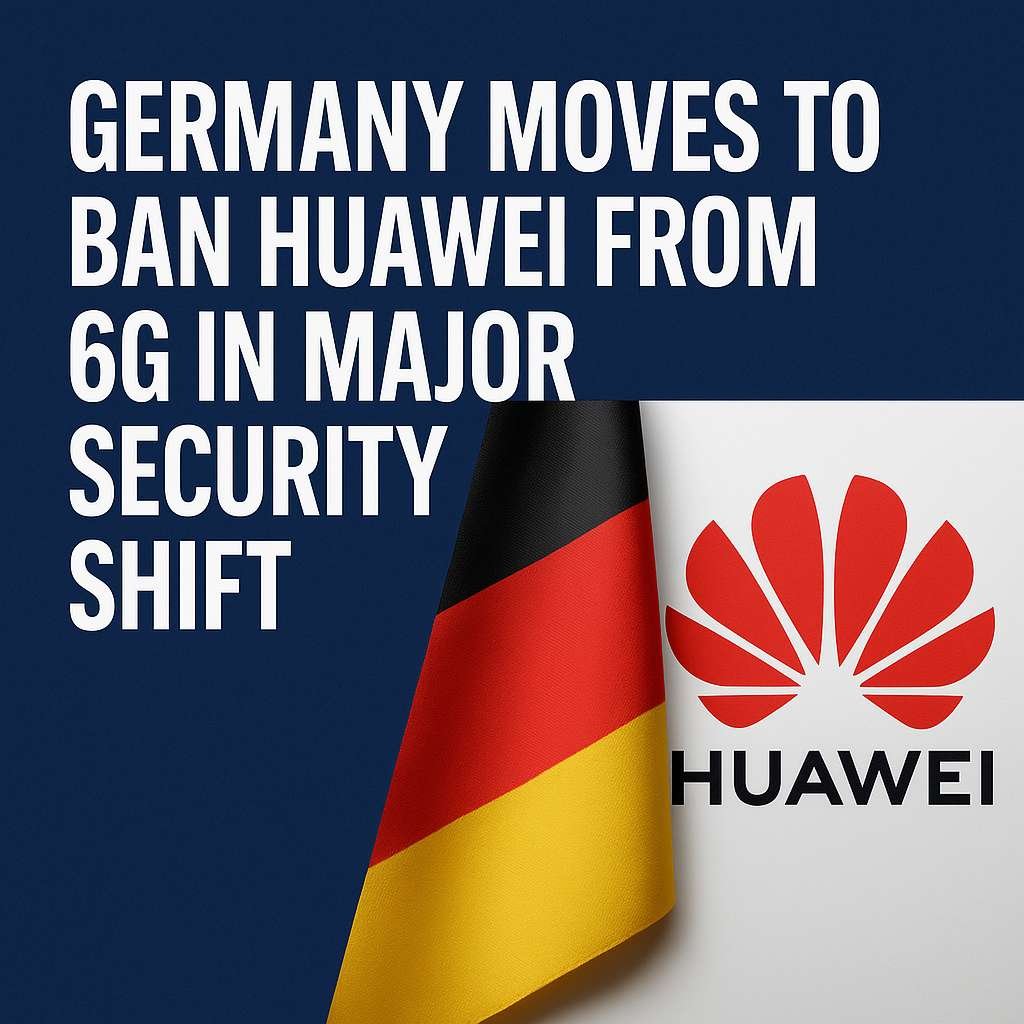
BERLIN (UNN) — Germany has moved to bar Huawei Technologies Co. from its future 6G networks, taking its strongest stance yet against Chinese telecommunications equipment and accelerating a wider European effort to reduce reliance on foreign tech suppliers.
Chancellor Friedrich Merz announced the decision Thursday, saying Germany will exclude all Chinese components from its 6G rollout and speed the removal of Huawei gear from existing 5G systems. The move expands earlier directives requiring telecom operators to strip Chinese-made parts from core networks by 2026 and from towers and antennas by 2029.
“We won’t allow any components from China in the 6G network,” Merz said at a business conference in Berlin, calling the step essential to strengthening national security and Europe’s digital sovereignty. He said he plans to meet French President Emmanuel Macron to coordinate broader EU efforts to curb dependencies not only on China but also on major U.S. technology providers.
Germany’s stance comes as the European Union is discussing legislation to bar Chinese telecommunications equipment from entering member states and to establish unified cybersecurity standards. Several European nations including the U.K., France and the Netherlands have already begun reducing or eliminating Huawei from their networks amid long-running concerns about espionage and cyber risks.
The shift mirrors a broader transatlantic trend. In the United States, Huawei has faced sweeping restrictions since 2019, when the Commerce Department added the company and dozens of affiliates to the Entity List, citing national security and foreign policy concerns. U.S. officials have alleged that Huawei’s equipment could be used by the Chinese government to spy on Americans or access sensitive networks accusations the company denies and have also cited violations of U.S. sanctions on Iran. In 2022, the Federal Communications Commission voted to bar new sales of Huawei equipment in the U.S., reinforcing the ban.
Washington has also used the Entity List and the Uyghur Forced Labor Prevention Act to blacklist numerous Chinese companies involved in human rights abuses in Xinjiang, including surveillance giants Hikvision and Dahua. Huawei has not been sanctioned for Xinjiang-related violations, but reports and a patent filing linking the company to technology capable of identifying Uyghur individuals drew international criticism. Huawei has denied supporting such applications.
China has sharply criticized Germany’s approach. The Chinese Embassy in Berlin said the restrictions were based on “groundless accusations,” arguing Huawei and ZTE have complied with German law and contributed to national digitization efforts. Beijing warned the decision could strain economic ties and damage China-EU cooperation.
Germany is considering public funds to help operators such as Deutsche Telekom replace Huawei components — a transition analysts say will be costly and could slow 5G and 6G deployment. Alternatives from Nokia, Ericsson and Samsung are more expensive, and Europe’s supply chain may struggle to meet rapid demand.
The move positions Berlin as a potential standard-setter for Europe’s next-generation telecom infrastructure. Analysts say that if Germany completes its phase-out of Chinese suppliers in both 5G and 6G, other EU countries may follow, reshaping the continent’s technological landscape.

Mamatjan Juma is the Executive Director of Uyghur News Network (UNN) and a longtime newsroom leader with more than 18 years of experience in international journalism. He previously served as Deputy Director of Radio Free Asia’s Uyghur Service, where he managed editorial operations, standards, and cross-language workflows and helped guide major coverage of China’s mass detention system, forced labor networks, and the expanding surveillance state in the Uyghur region (East Turkestan).
Under his editorial leadership, RFA’s Uyghur Service received major journalism honors, including the Burke Award (2019) and the MINS Award for excellence in international broadcasting. Its reporting has been cited by major international outlets, helping shape global understanding of the crisis. Juma is fluent in Uyghur, English, Mandarin Chinese, and Uzbek, and also works as a translator.





Be First to Comment